
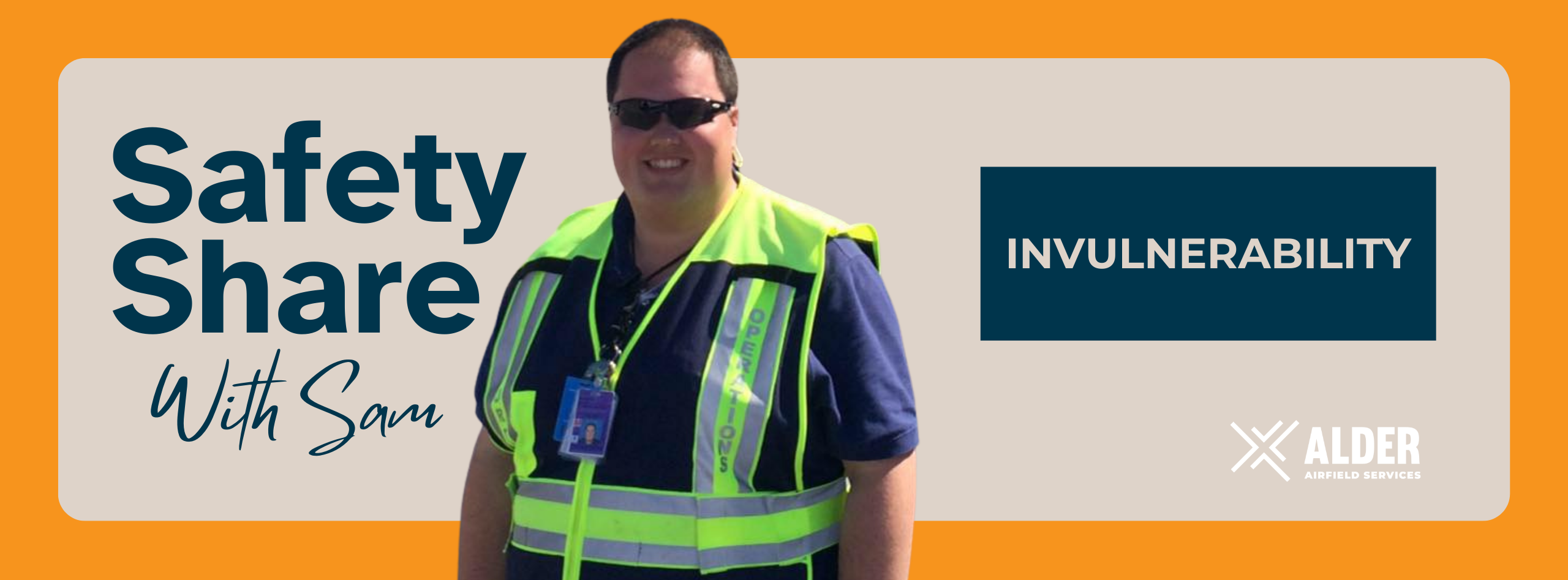
By Samuel Allen, C.M., ACE
Airport Operations Manager
Despite the airport environment being unlike any other work environment, common problems and challenges persist. In a “normal” setting, multiple chances to get things right are commonplace, often resulting in perseverance being at the forefront of workplace mentalities.
Oftentimes though, the airport can be a high-consequence locale, prohibiting multiple chances if one is unfortunate enough to have multiple safety mechanisms fail and an incident occur. Even with the risks so high, one common human factor can undermine even the best safety culture: invulnerability.
What is invulnerability?
Invulnerability is characterized by the mindset, “it won’t happen to me” and specifically described by the FAA as “Many people falsely believe that accidents happen to others, but never to them. They know accidents can happen, and they know that anyone can be affected. However, they never really feel or believe that they will be personally involved. [Individuals] who think this way are more likely to take chances and increase risk.”
How does it show up on the AOA?
In airport construction, invulnerability often hides behind experience.
A worker who has operated equipment for 20 years without incident may begin to trust instinct over procedure.
Another who has crossed a taxiway dozens of times without issue may stop scanning as carefully as they should.
A supervisor facing schedule pressure during a short closure window may convince themselves that skipping one step in a protocol is low risk.
Situations like these can seem innocuous at first, but over time can lead to a general lowering of situational awareness and lack of execution of coordinated means and methods.
Warning signs
As airport environments are unforgiving, past success does not reduce future risk; in fact, it can breed complacency which is often the start of the recipe for invulnerability mindsets. Warning signs of invulnerability are subtle but visible. Workers may skip personal protective equipment “since it doesn’t really matter.”
Safety briefings may be dismissed as an unnecessary and repetitive chore to “check the box.” Spotters may be waved off or outright ignored. Comments like, “I’ve done this a thousand times,” or “we’ll be fine,” perpetuate normalization of unnecessary exposure to additional risk. When these attitudes go unchallenged, they become embedded in a crew’s culture along with the general feeling of the project.
Combatting invulnerability: practical tools
The antidote once invulnerability sets in is deliberate and pointed counter thinking. The FAA’s recommended counterstatement to invulnerability is simple: “it could happen to me.” This shift in mindset restores personal ownership of mitigating risk. Leadership plays a crucial role in reinforcing this mindset.
When supervisors model strict adherence to procedures, they send a powerful message by example. When experienced workers
demonstrate humility and discipline rather than overconfidence and invulnerability, the less experienced amongst the crew often follow suit simply by a positive derivative of peer pressure.
Practical tools can also help and are often the most effective thanks to their simplicity. Daily hazard assessments force teams to factor in changing conditions to work toward their goal. Peer-to-peer safety observations encourage accountability. Structured safety stand-downs create space to discuss close calls before they recur and become incidents. Most importantly, a strong speak-up culture empowers the individual to question unsafe decisions and actions.
Why does this matter so much specifically on an airport? Aviation and construction generally demand precision, coordination, and discipline as separate industries. However, when you combine the two, the precision, coordination, and discipline required for safe execution of a project becomes exponentially higher (as perceived by this airport ops guy).
Experience is invaluable, but it does not bring with it immunity from the consequences of improper actions. The margin for error is thin on an airport, and consequences extend beyond the job site to aircraft, airlines, the traveling public, and sometimes the entirety of the National Airspace System (NAS) in the case of a closed runway/airport due to an incident.
In airport construction, regulatory and procedural compliance is not weakness as it is a critical layer of protection for all involved. Everyone is valuable; no one is invulnerable.